One Standard Poutine can power your brain for 48 hours. GPUs need a lot more.
 Laurent Maisonnave on Oct 2, 2026
The human brain is amazing for many reasons, and one of the biggest is its efficiency. It runs on 20 watts.
When you’re thinking really hard it might peak at 25 watts. While you’re asleep it might drop to 15 watts, but on average, your brain runs on 20 watts throughout the day.
In a moment we’ll compare that incredible efficiency to some GPUs, and eventually we’ll get to the point of this blog post - but first let’s visualize that 20-watt consumption in a new way.
A comparison is often made between the brain’s power footprint and that of a low-powered lightbulb. It’s accurate but not very inspiring (or very human) so let’s start somewhere else:
- Your brain is powered by food
- Because we’re a Canadian company, we’ll assume that your brain is powered by Canadian food (many of the best brains are)
- Our unofficial national dish is poutine, a glorious mix of French fries, cheese curds and gravy*
- With these facts established, we can turn to an important question: can we work out how much poutine will power your brain for a day?
How much poutine powers your brain for a day?
First, we need a way to convert poutine power into brain power, so we will establish a new unit called the Standard Poutine. You read it here first.

1) Food energy is measured in thousands of calories, or kcal. Taking an average of poutine recipes that we know and love, and recipes published by a few well-known chefs… we get a value of roughly 800 kcal per poutine.
That’s quite a generous poutine portion already, but let’s add some more cheese so that our Standard Poutine reaches 826 kcal. That will make the numbers nice and easy in just a moment.1 Standard Poutine = 826 kcal
2) Next, we need to work out how to convert food energy into brain power. The brain runs on 20 watts, or 0.02 kW. Multiply that by 24 hours and you get 0.48 kWh for a single day:
0.02 kW x 24 hours = 0.48 kWh per brain per day
3) Now we need to convert kWh into kcal. 1 kWh is the equivalent of 860.421 kcal, so we can work out the kcal consumption of your brain for a day:
0.48 kWh x 860.421 kcal = 413 kcal per brain per day
4) Finally, we have an answer. Thanks to the cheese we added earlier, we know that a Standard Poutine is 826 kcal, so we can determine that:
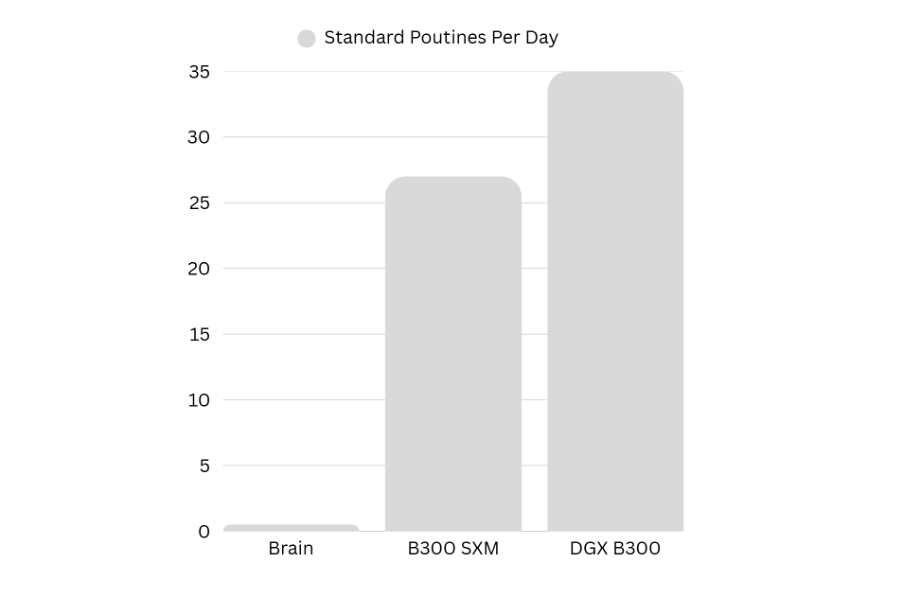
1 humain brain runs on 0.5 Standard Poutines per day
In other words, one Standard Poutine could power your brain for 48 hours. Pretty neat, right?
What does this have to do with GPUs?
The brain is a marvel of organic engineering. Those 20 watts power training, fine-tuning and inference all at once, and a Standard Poutine will run your brain for two whole days.
In the data centre, AI training, fine-tuning and inference are discrete tasks that depend on GPUs, and GPUs need a lot more poutine than that. How much more? Let’s run the numbers for the latest NVIDIA generation.
According to NVIDIA, a B300 SXM consumes a maximum of 1.1kW at full load, or 26.4 kWh per day:
1.1 kW x 24 hours = 26.4 kWh
= 27.5 Standard Poutines per GPU per day
--> 55x more than your brain
The DGX B300 super-compute module is even more power-hungry, with each GPU in the module consuming a maximum of 1.4kW at full load, or 33.6 kWh per day:
1.4 kW x 24 hours = 33.6 kWh
= 35 Standard Poutines per GPU per day
--> 70x more than your brain
As the AI industry races to approach human general intelligence - or even surpass it, according to some - the sheer orders of magnitude in power consumption give us a sense of the gap to close on Mother Nature. Hundreds of millions of years of unforgiving natural optimization (a.k.a. evolution) have forged organic brains that GPU infrastructure needs monstrous brute force to even begin to compete with, in terms of efficiency.
What's the point of this? It's all about power.
As well as being kind of a fun exercise** this is a meandering way to talk about the CarbonForge mission: the need to find greater efficiencies in the infrastructure that powers AI. It’s something very close to our hearts as well as our brains.
In many ways your 20W brain out-thinks every AI data centre on the planet. To create AI that even gets close, the industry is investing billions not just in new AI data centres with GPU infrastructure, but also in the multiple gigawatts of power needed to run them. That isn’t going to change – the direction is set – but what we can change is the amount of intelligence delivered by each Watt consumed in those data centres or your local hosting site.
How? That’s the CarbonForge “secret sauce” used to optimize the performance of LLMs used for AI, and it starts with the thing we’ve been covering throughout this post – power.
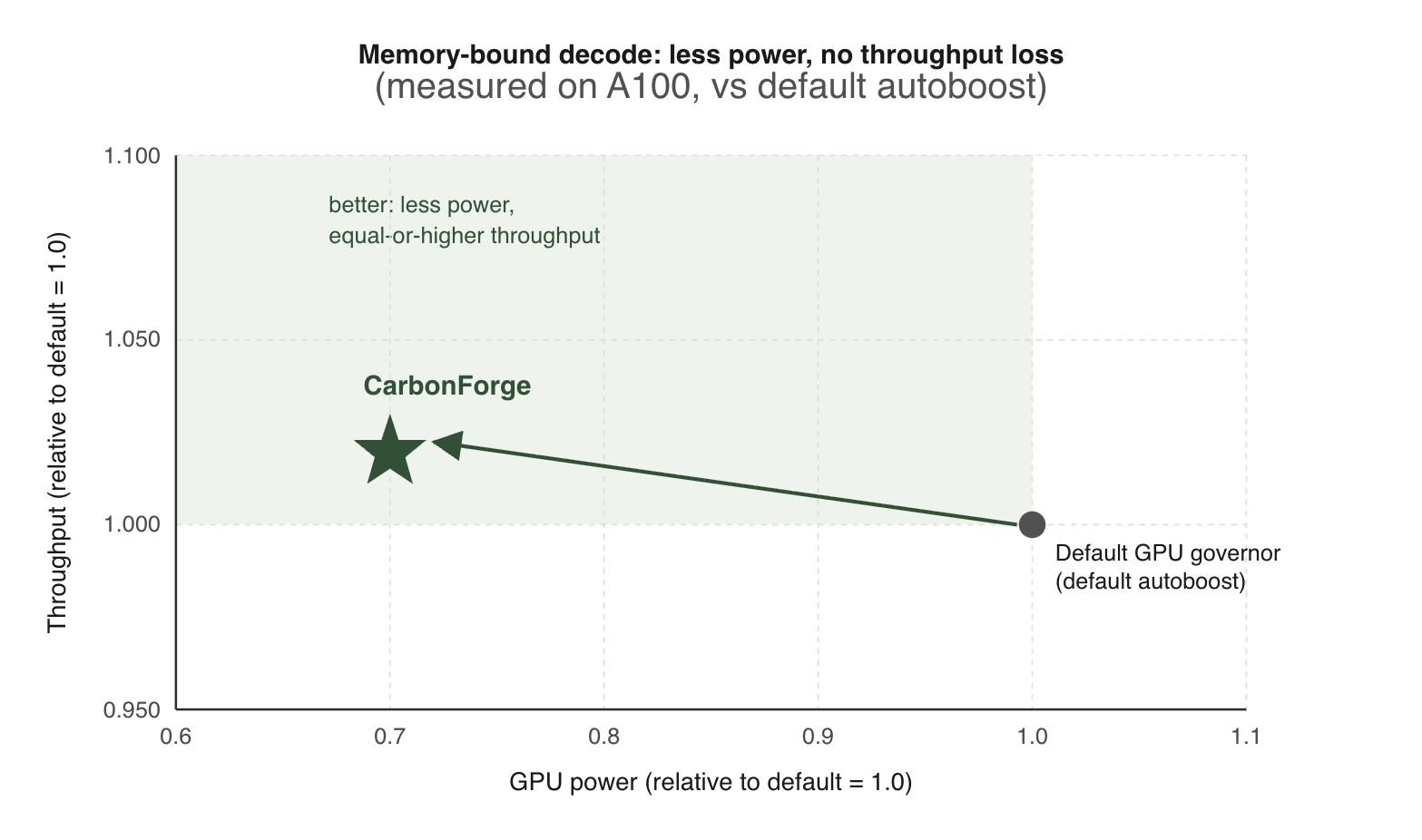
By measuring power consumption at the lowest level, on live production workloads, and by testing and applying LLM optimizations tailored to specific workloads, GPUs and desired outcomes, we can reduce power consumption and improve intelligence output at the same time.
How to get started
Want to improve the efficiency of your own AI workloads? We package LLMs as pre-optimized, ready-to-deploy containers, or we can also host optimized models for you as OpenAI-compatible endpoints. Just get in touch to discuss what you need!

Additional notes
* Fun fact: according to Guinness World Records, the largest ever serving of poutine was produced on 3rd August 2019 by Les Fromages de Warwick, in the official birthplace of poutine - Warwick, in Canada. It weighed more than 3,000kg, required 42 deep fryers, 300 people, and needed its own optimized container. We’re not sure of the calorie count – it may have been the first example of a Standard Mega Poutine.
** This is a light-hearted blog post, and obviously open to hole-poking from anyone with a modicum of knowledge about how bodies and datacentres actually work. Feel free to comment on our LinkedIn post. :)
One obvious omission here is power conversion efficiency. The human body is not particularly good at converting food energy into useful brain work, mostly because we are warm-blooded and need to turn food into heat to survive. If you think of the body as the PSU for the brain, it’s only operating at about 20% conversion efficiency. Taking that into account, you might need to eat two-and-a-half Standard Poutines per day to power your 20W brain.
Conversely, in the datacenter, Platinum-rated PSUs are extremely efficient, especially under load – reaching 95% power conversion efficiency in the best cases. That 5% still means we should add a little poutine to those NVIDIA numbers, taking the B300 SXM up to nearly 29 Standard Poutines, and the DGX B300 to almost 37 Standard Poutines per day.
However, that ignores CPU, cooling, storage, networking, and all kinds of other vital power-consuming components in the data center, which would skew the numbers back towards the good old human brain. Could we factor this in? Yes, but it would be taking this comparison too far.

First Fable, then NVIDIA and HuggingFace. Is it time for Owned Intelligence?
Adaptive SM clocking for energy-efficient LLM serving