How CarbonForge can help companies improve their intelligence strategy and ownership.
 Laurent Maisonnave on Sep 11, 2026
It seems that we are at an inflection point, perhaps even a tipping point. Companies are re-evaluating their AI strategy and asking an important question: is it time that we owned our intelligence?
In June 2026, the US Government issued an export control directive and shut down the newly-launched Fable 5 for a period of 19 days. It was a wake-up call for companies whose products and processes were solely dependent on Anthropic, or any proprietary API.
Fast-forward to September 3rd and the news that NVIDIA has agreed to acquire HuggingFace, the largest repository of open-weight models and the main distribution hub for proprietary API alternatives. NVIDIA’s position: HuggingFace will remain open, GPU-agnostic and cloud-agnostic. Quite a few people have doubts about that. Is this another wake-up call?
How much of your AI stack do you need to own?
Whether you believe that HuggingFace will remain a level playing field or not, it certainly highlights the potential for change in a space that many of us felt was inviolable.
Two truths here: whether or not the delivery channel changes, open-weight models will persist; and in the real world, most companies depend on commercial and/or proprietary vendors somewhere in their intelligence stack.
The important focus here is not achieving 100% independence of third parties - unless you are very small or very large, that will probably be impossible - but maintaining control of the most important component, the intelligence itself.
Three reasons to change your intelligence strategy
Why should you own your own intelligence? There are three compelling reasons. As the Fable launch proved, it’s a bad idea to pin your intelligence strategy on a technology that can be influenced by forces outside of your control. That is the first driver for intelligence re-evaluation, and enterprises using frontier models have been scrambling to build more redundancy into their intelligence stack. “Multi-provider AI gateways” now exist as a solution category.
The second driver is tokenomics. There has been a clear trend in meetings we’ve had with enterprise AI teams this summer. Once ChatGPT reached maturity, many companies dissolved their ML teams and stopped trying to build their own models. They adopted frontier APIs instead. 
The same companies are now slowing down projects because they are not viable at the current throughput cost. Their bill compounds with usage, and the numbers just don’t add up.
The problem is not with any single lab or vendor. It’s with the assumption that frontier intelligence must be rented from a frontier API – an assumption that is now incorrect, and that leads us to the third compelling reason for change.
Now everyone can own frontier-class intelligence
Open-weight models reached frontier-class quality this year. Models like Qwen can now scale to trillions of parameters and perform at a similar level to GPT, Sonnet and Gemini.
The difference? With our containers, the weights are yours. The container can run anywhere, and you are no longer tied to a proprietary frontier API. With our endpoints, you can switch anytime. Either way, you have more control of cost per token, and the savings can be used to deliver more output.
We call this category Owned Intelligence. Your own frontier intelligence stack, enabled by open-weight models and paired with a minutely customized optimization.
What does Owned Intelligence look like?
We’ve covered the problem of dependence. Owned Intelligence is the opposite: it’s about lining up partners around your need for the model, the container, the cloud infrastructure, the inference engine and the optimization tools. No team migrates from frontier APIs on its own. No single vendor can cover your whole path.
Adopting a frontier model might feel like a ‘silver bullet’ solution, but at the end of the day, it’s still a bullet. Owned Intelligence is about freedom through diversity and choice and control.
How does CarbonForge help?
We provide part of your Owned Intelligence strategy. When companies moved away from in-house ML development, their teams often moved away too. They no longer have the skills or resources to tune open-weight models for optimal delivery of intelligence.
We package the answer as a simple container or endpoint, optimized for your model, your workload and use case. A container holds the open-weight model, vLLM and the optimization engine. You download it, it runs on your existing stack. An endpoint is a simple swap to your frontier API.
Our optimization engine locks the operating point that holds output quality at your target, and delivers more intelligence per dollar versus stock model configurations – and if your needs change, or your workload evolves, it adjusts automatically to keep that performance steady over time.
Now you own and control your intelligence, gaining performance and agility in the process.
Sounds good? Join our waitlist to access our optimized containers or endpoints, depending on your stack and use case. Limited spots for the first round.

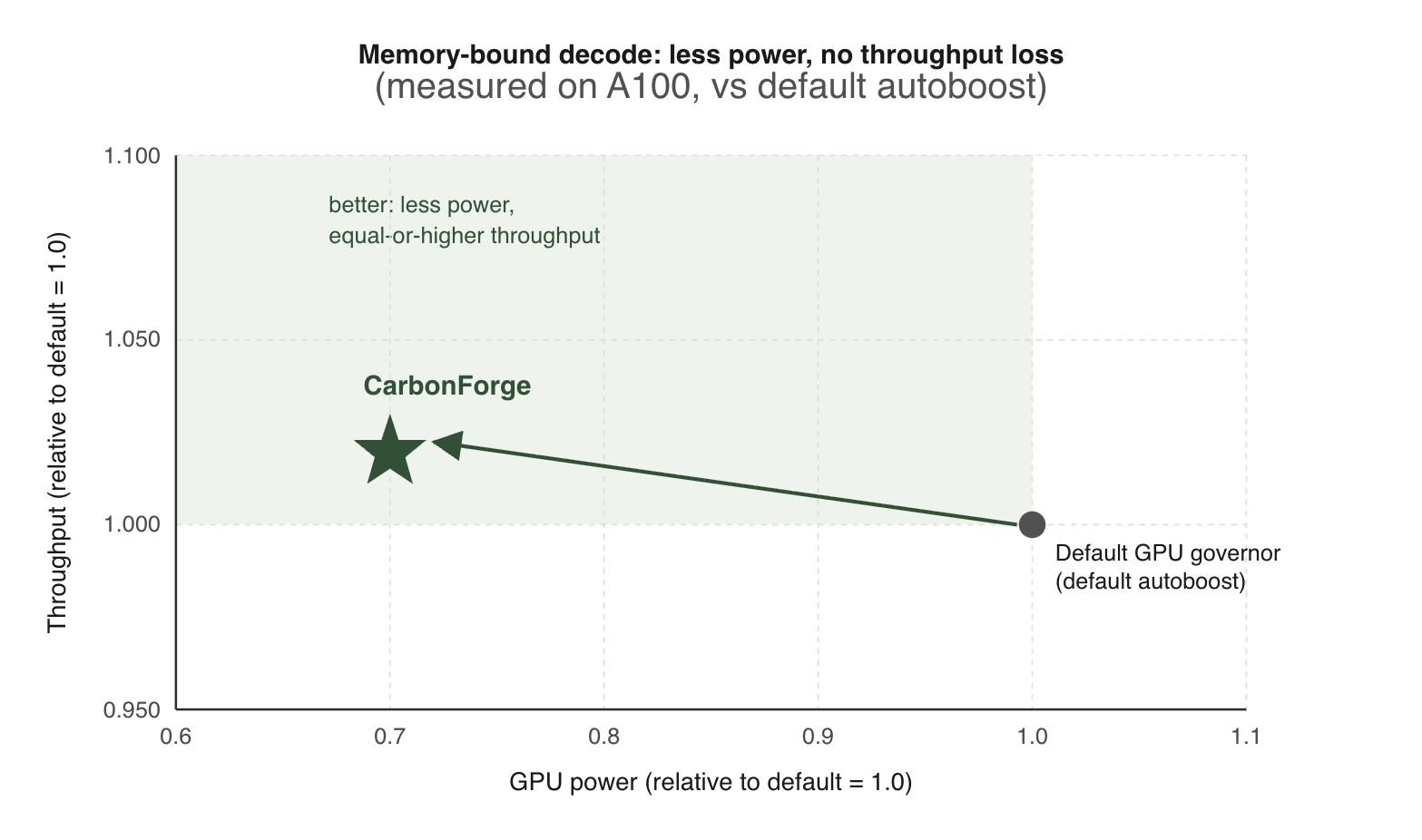
Adaptive SM clocking for energy-efficient LLM serving